
- R.W. Emerson, 'The American Scholar'
“For Vico, the peculiar intelligibility of history rests upon insights into our own nature which are accessible to us by virtue of our capacity to reflect upon ourselves in our various social and historical activities, so that we can be aware not merely of the different ways in which we see and react to our world but also of the different conditions which cause us to see and react thus.”
– Leon Pompa, 'A Study of the New Science'
“The things I have read are far more interesting than the things I have written.”
– Jorge Luis Borges, 'This Craft of Verse'
"[To be] human is essentially the process of the adoption of the past, and of technics, and it is the same... Technics is always new, we must always adopt it. We are fundamentally caught in a process of adoption."
Bernard Stiegler, perf. The Ister.
Dir. David Barison and Daniel Ross.
Black Box Sound and Image, 2004.
Dir. David Barison and Daniel Ross.
Black Box Sound and Image, 2004.
a book and a book about that book
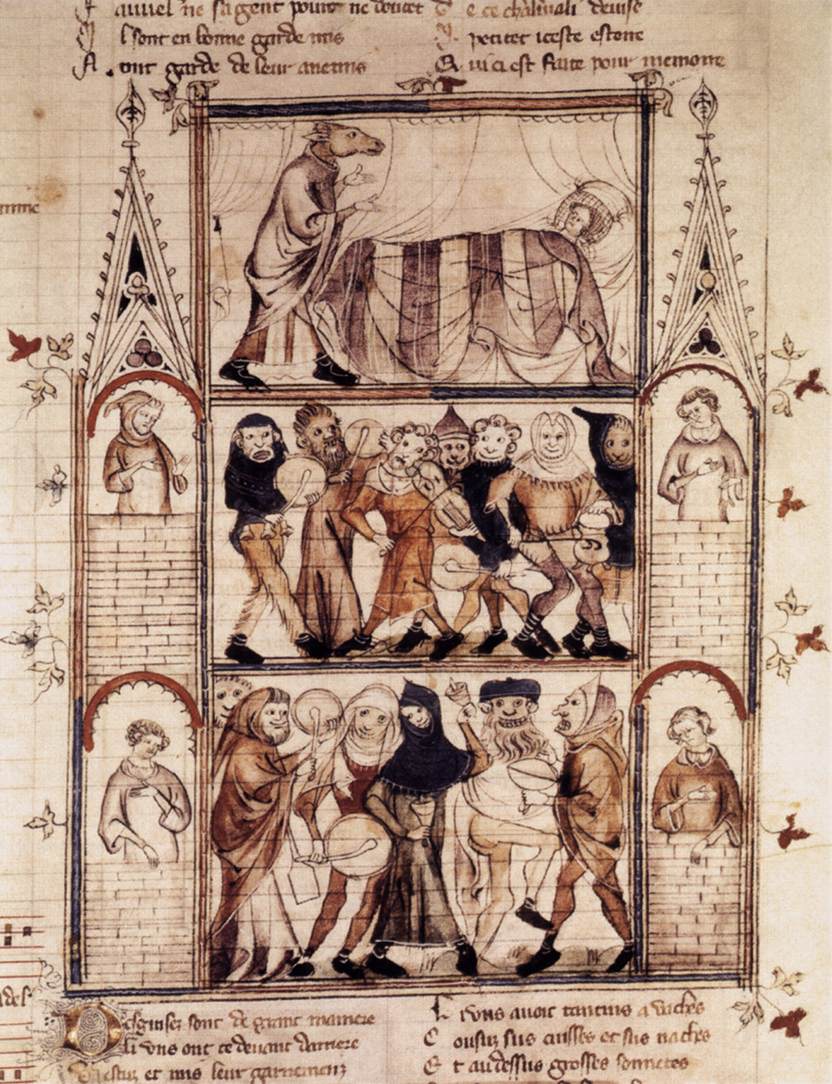
I would like to start this conversation with a book, a very specific book, very old and very long, and also with a book about that book, perhaps not a 'new' book anymore, but young in comparison to the first;– The first book is called BN fr.146, the precise if not so catchy library index number of a copy of Gervais du Bus' poem Roman de Fauvel, with additions (poetic and musical) compiled by Chaillou de Pesstain. The text of Roman de Fauvel was wildly popular throughout the 14th Century and well into the 15th Century, with many copies surviving to the present day. BN. fr.146 seems to have been assembled in Paris sometime around the coronation of Phillip V in 1317, (1) and is held by the Bibliotheque Nationale, having moved not all that very far in its 700-odd years of existence.
The narrative of Gervais' text falls out roughly like this: an ambitious and not particularly bright donkey named Fauvel becomes dissatisfied with his life in the stable and removes himself to the largest room of his master's house. Dame Fortune, the goddess of Fate, smiles upon Fauvel and appoints him leader of the house. Church and secular leaders make pilgrimages to see him and bow before him in servitude. Upon receiving Dame Fortune's smile, Fauvel asks for her hand in marriage. His suit is rejected, but he is offered instead the hand of Lady Vainglory and a lavish wedding follows. The Roman de Fauvel is both comic and rude, laden with allegories and political satire. The donkey's name is a portmanteau of "veiled lie" (fau-vel) and is an acrostic of the initial letters of the seven deadly sins: Flatterie (Flattery), Avarice (Greed), Vilenie (Guile), Vanité (Vanity), Envie (Envy), and Lâcheté (Cowardice). The visitation of church and secular leaders symbolizes Church and state rulers bowing to sin and corruption. The wedding guests include Flirtation, Adultery, Carnal Lust, and Venus. And Fauvel's fate, revealed by Dame Fortune, is to give birth to more iniquitous rulers like himself, leading to the eventual arrival of the anti-christ.
This copy of the Fauvel, BN fr.146, attributed to Chaillou de Pesstain has a particular value for musicology in that Chaillou has added to 56 Latin and 113 French motets and lyrics (in addition to some 3000 verses in the text), a wide ranging anthology of thirteenth and early fourteenth century music (including many works by Phillipe de Vitry). The book is thus rendering it a compendium of music from the emergence of the Ars Nova and the music proceeding it. Many of these were altered by new music and/or texts to relate existing pieces more closely to the theme of Fauvel, recasting single voices from conductus and motets, and migrating works from one polyphonic genre to another.
The book about this book is Emma Dillon's Medieval Music-Making and the Roman de Fauvel (New Perspectives in Music History and Criticism). Published in 2002, the text explores the role of music in early fourteenth-century Paris. The musical supplements in Chaillou's Fauvel are frequently used to illuminate the wider history of French medieval music, but by studying the relationship between music and text in this particular Fauvel, and the materiality of the practice of codex-making more generally, Dillon focuses on musicking; not simply the work's linguistic texts and musical pieces, but the question of what it was to make a book of music, what it was to make music; and especially what it was to 'create.' Dillon carefully reviews the appearances of images of authors and readers in this and other texts of the period and earlier, considers the emergence of private reading in those images (Dillon, 103), and demonstrates this changing understanding of reading as an increasingly private activity through the disappearance of the lectern from many of these images over time.
Dillon very carefully explores the particular manner or manners in which Chaillou manifests in Gervais' text. Chaillou is present as speaker in the text, interrupting the speech of Dame Fortuna to recount his own views on the matter and something about his own life. Now, to be clear, who this Chaillou is is far from clear; the book is filled with hints that Chaillou is a nom de plume, or a composite of several people. He is represented visually in several illustrations in the work, and he is also present in a profound way in the musicality of this book - each musical work interpolated into BN fr. 146 is an interruption or expansion of Gervais. (Dillon 73-74). We should remember, though that Gervais' text did not emerge de novo, but draws on themes, tone, and characters (including Fauvel) from narratives and poetry and historical events, being a particularly extensive or excessive case of the literary adoption and transformation that was a commonplace of the period (Dillon 18-20). For Dillon, the story of BN fr.146 is a tale of Chaillou reading Gervais reading; each act of writing is an act of reading, and vice versa.
In the book's third chapter, Dillon describes facets of authorship in Paris in the period, and ties these aspects to postmodern riffs on the disintegration of the author-function. She says:
"While the deconstruction of the author is most famously associated with a strand of modern critical theory, the dismemberment of the author has found quite surprising and eloquent expression in the field of Medieval studies — in fact, Foucault's and Barthes's ideas of authorship seem remarkably consonant with certain medieval notions of the author." (65)
Dillon is certainly not the first to highlight these parallels to writings like Barthes' 'The Death of the Author' (2) and Foucault's 'Qu'est-ce qu'un auteur'.— Roger Chartier, Kevin Brownlee, Alistair Minnis, Mary Carruthers and David Hult (3) have all explored the procrustean risks of authorship in contexts where the notion is anachronistic and the seemingly perpetual problematic of individual and agency.
authorship and composership
The Commentarius in primum librum Sententiarum Petri Lombardi of Bonaventure (1221 – 1274) serves as the springboard for Dillon's discussion of the period's understanding of authorial roles. These roles were often framed in ethical terms, since false interpretations or statements would place the author in moral hazard by misleading the reader.
Bonaventure, an Italian scholastic theologian philosopher, Saint, Cardinal, and Minister General of the Order of Friars Minor, lists the ways that a book should be made by naming four different roles for the producers of the book (Dillon 70):
- The Scriptor adds nothing to the book he produces, replicating a preexisting text as identically as possible;
- The Compilator writes other peoples words but is selective, choosing what is retransmitted to demonstrate particular point or emphasize particular features;
- The Commentator places others' words in a position of primacy first, but adds his own words for emphasis, clarification, and expansion;
- The Auctor writes both his own words and the words of others, with his words making the argument which is confirmed by the others.
The plurality of modes of authorship in Early Modern musical practice is a great place to begin to understand the plurality of our own practices of composering, and the personae which composers of today adopt in their music and how they speak and write about those works. Composers are today in a highly dynamic aesthetic and economic environment. With the rise of digital audio technologies, the nearly complete penetration of a reified, commodified business model for music making, and the complex and still unfinished rise of social media networks as the most significant distribution network for new music, the modes of being of composership are rapidly changing, a situation reminiscent of Chaillou's Paris. It was a locus of tremendous intellectual, aesthetic, and practical upheaval. Notation and the mechanisms of score production and the nature and context of performance were undergoing great changes. Artists were functioning as technologists, as performers, and as scholars, and were using and utilizing a variety of media to effect and benefit from these changes, and taking a variety of stances about aesthetic, economic, and historical challenges.
What I find most striking about Bonaventure's analysis is the absence in any of his four roles of a singular, autonomous author. Even the Auctor, the most individuated of these roles, is involved in a complex process of recapitulation of thought;– a work or text is new only by the manner in which it articulates the past. The Medieval codex (with the Fauvel as an exemplar, not an exception) reveals the long standing, perhaps eternal character of the musical work as an assemblage; it is a trace on vellum of complex musical practices, with many individuals contributing to each book, and each expressive gesture.
This tension between creation and recapitulation mirrors two seemingly contradictory tendencies in my own composing life. The first is the perduring notion of the composer as an autonomous individual, perhaps not as heroic as our Romantic predecessors, but endowed with agency;– my work is mine, the work of my hands, and distinct from others' works. The second is an increasing clarity around the emplacedness of a work within a compositional heritage extending back to the time of the Fauvel.
three and a half topoi
A serious consideration of the project of Early Music can aid composers and scholars of Contemporary Music practically and critically. A consciousness of one's own historical situation can aid composers in developing a deeper and more critical understanding of todays social, cultural and philosophical state of play. Actively or passively Classical, jazz, pop, and world music provide professional and aesthetic foils for one another, either through proximity and continuity or distance and discontinuity.(4)
The practicing composer takes stances, consciously or unconsciously, on these questions of tradition, change, and originality with every composition, performance, or statement. The past's aporia between presence and absence is what lends it the power of anamnesis, of un-forgetting, of unpacking the ideologies of music-making, which have, through time, become invisible and inaudible to us.
I said earlier that we would see how 'Early Music' can serve as a cipher to understand the 'classical' in music, how composition is inescapably involved in a process of technical adoption, and how the very notion of the autonomous composer is an historical construct.
1) Early Music and its musicology enables and obligates us to articulate our historically affected consciousness;— by virtue of its temporal remoteness Early Music is, for me, the musical practice that operate the furthest from the unstated and well-theorized but under-critiqued metaphors that shape musical living today, like werktreue, high/low divides, the market place, and the work-concept.
1a) Furthermore, 'Early Music' is a cipher for the puzzle of "Classical Music";— we'll see the role of classicism in the formation of the western art canon, as well as the persistent (though shifting) role of that canon in the current terrain of musical activity, and will see how Classical music's aspiration to the eternal continues shape musical practices, in parallel and in opposition.
2) Composition is a process of technical adoption;— By considering Stiegler's notions of technics and Gadamer's philosophical hermeneutics we will see how heritage and tradition have and can continue to have a role in compositional practice which is critical, revolutionary, and radical.
3) The autonomous composer is a figure constructed in an historical context;— the fall of the notion of genius and the 'death of the author' are actually reassertions of the state of play before the rise of the classical in music.
History is not a burden or a hinderance– it is the ground for expressions' figure. Ricoeur says that one problem is to avoid the opposition of memory and tradition with imagination. (5)
The process of recapitulation and variation and amendation that we saw in the writing and rewriting of Gervais and Chaillou are precisely such a generative opposition.
=======================
1 Dillon, 2002, 17-23
2 in Image, Music, Text
3 Roger Chartier's The Order of Books, Alistair Minnis' Medieval Theory of Authorship, Mary Carruthers' The Book of Memory and David Hult's 'Self-Fulfilling Prophecies' are at the top of a lengthy reading list regarding authorship in the Early Modern.
4 A composer must distinguish themselves from their peers to gain performances and commissions, and an early music thread in one's own stance can help distinguish a composer from the pack. It helps establish a profile which is neither the stately radical Modern, nor the pop-ist populist, nor the highbrow Classical reactionary. Early Music can be an Other, a special niche which is distinct from but not threatening to the status quo of 'classical music' practice.
5 Ricoeur, "Memory, History and Forgetting"