
 |
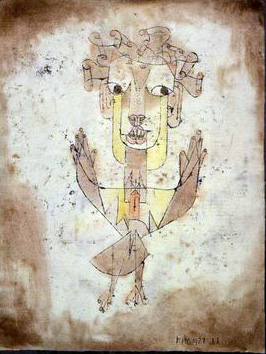
| Paul Klee's Angelus Novus [ Link to source here ] {{PD-art}} |
A friend recently recommended that I read Michael Löwy's 'Fire Alarm;' he was surprised that I had never read it, given its intersections with many of my intellectual and artistic interests. By a few pages in, I was similarly surprised that I hadn't come across this little book. It is like a gem with hundreds of faces and with the density of a neutron star. 'Fire Alarm' contextualizes Benjamin's Über den Begriff der Geschichte and its description of the tension between destruction and progress, a tension at the center of so much artistic and political in the newly historical 20th century, and the perennially novel 21st century.
Benjamin's redemptive catastrophism connects to many aspects of aesthetic production, and seems of particular relevance to composition, but I will leave a full interrogation of those connections to future posting, perhaps a running catalog of sightings in concert life and the blogosphere. Here I'll look at something rather smaller;– Benjamin's Xth thesis and its warnings against false consciousness and its evocations of monastic 'retreat.' This is a theme of the text that might seem to have few implications for the New Music, but seeming is often revealed as different than being.
Thesis IX serves as a lens that focuses the central themes of Über den Begriff der Geschichte. Here, through an ekphrasis of Paul Klee's Angelus Novus, Benjamin articulates a vision of the Angel of history as he is ejected from heaven, pushed by a storm, 'the storm that we call progress.' Many of our post-post-modern practices of musiking organize the act of music making as a reassembling of the shattered materials of history. Collage, polystylism, totalism, post-classical concert/popular hybridization;– all these historical-poesic stances resonate with Benjamin's backward-looking, forward-moving angel of history.
Given the dynamism of the rest of the text and (in particular) the immediately proceeding thesis, the Xth can seem a puzzle to readers, introducing as it does the notion of monastic retreat in the midst of a text very strongly embedded in and concerned with the impact of philosophical and spiritual stances, very 'in the world.' The questions of greatest immediate concern to Benjamin (fascism, Naziism, and the transition in communism from a revolutionary mode to a statist mode) are brought up or hinted at in this thesis, but the most interesting element to me is the connection made between his own critical project and Christian monastic traditions and their seeming retreat from the world.
The objects which the monastic rules assigned to monks for meditation had the task of making the world and its drives repugnant. The mode of thought which we pursue today comes from a similar determination.
An evocation of the spiritual in everyday life is not surprising from an author with such a strong theological bent; indeed, Löwy describes Benjamin's theory of history as a theology rather than a philosophy. But even so, the quiet remove of monastic life seems far from the tumult and energy of the rest of the text. Is this an echo of the utopia of Tolstoyanism? Is it a foreshadowing of intellectual retreats from totalitarianism such as the Paltanis group in Romania? Perhaps, but if so the thread is not picked up in later theses, and the idealisms of such projects (either the spiritual idealism of Tolstoy or the philosophical idealism of Noica) seem not to jibe with Benjamin's unabashed pessimism and relentless search for an honest and useful analysis of conditions of modernity.
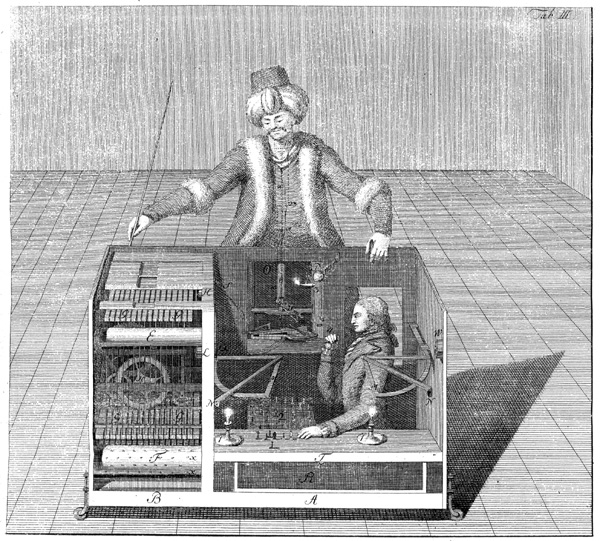 |
| An engraving of the Turk from Karl Gottlieb von Windisch's 1784 book Inanimate Reason. [ Link to source here ] {{PD-art}} |
The puppet called “historical materialism” is always supposed to win. It can do this with no further ado against any opponent, so long as it employs the services of theology, which as everyone knows is small and ugly and must be kept out of sight.The tension between the seen and the unseen implies that readers should question their own assumptions and ideologies about history, and by implication, politics, and by situation, modernity. Specifically, it asks us to question the rhetorical mythologies of progress; it critiques and rails against failures of systems of thoughts and social and political movements, but does so to promote in the reader an ability to see the dwarf within the turk. As Löwy points out, Benjamin draws upon the idealisms of Fourierism and the work-based optimism of Dietzgen to critique naive, ersatz historical materialism for its passive reliance on technological advancement; the belief in the inevitability of socio-economic advancement (through some technical means) toward a Marxist utopia. The critique is not a simple pessimism, though;– through its evocation of monastic discipline the thesis puts forward a path to a different situation, a better way of being, via actual or metaphorical messianism towards tikkun and apokatastasis.
Benjamin's redemptive catastrophism affords positive and negative readings;– the wreckage cascading in front of the angel produces a mourning of that which has been fragmented by the storm front, establishing a prerequisite of remembrance or mourning for citizenship in the community of moderns. At the same time the bricolage of the fragments of the past into new artistic materials is an opportunity for redemption;– for artists, the act of reassembling these shards is an act of redemption, while for Benjamin each moment of the catastrophe contains within it the possibility of a return to utopia, an opportunity for messianic return.
These elements are not in simple opposition to one another; Benjamin is not suggesting that we avoid one and focus on the other. They are two aspects of the same situation. In naive historical materialism, the metaphysical component is obscured by the false sense of progress, and that is what seems to stick in Benjamin's craw. In his first thesis, Benjamin used the 18th century seemingly miraculous but finally duplicitous chess playing automata as a metaphor for historical materialism's embarrassment and shame concerning its theological aspect; it is the hiddenness of the dwarf inside the automaton that is problematic rather than the fact of that dwarf that Benjamin focuses on. It is the conflict between the rhetoric of historical materialism and the fact of its theological and metaphysical underpinnings that is the root of the issue for Benjamin. This is where the function of his evocation of monastic 'retreat' becomes clear. Benjamin fears naive progressivism, fears the belief that the storm ineluctably leads us back to paradise to or forward to a new utopia; such simple belief produces blind spots that are dangerous. While identifying the specific traps of his time for naive, progressivism (the decline of Trotskyism, the Ribbentrop pact, etc.), Löwy points out how Benjamin articulates for us a more general fire alarm for the dangers of false consciousness. The discipline and critical distance of monastic rules provide a space and opportunity for reflection and analysis that might pierce the confusion of the Now.
As moderns, and as moderns of the musical variety, the thesis is a call to examine our situation, and challenge prevailing notions about how the future will come to pass. Modernity poses a danger to us of a confusion mishmash of catastrophic debris, but for Benjamin, it also offers countless opportunities for redemption. Klee's angel is (for Benjamin) the angel of history, but his situation is our situation, and so we are faced with the same challenges; redemption or idolatry. Benjamin's evocation of monastic discipline within the context of the maelstrom of the storm of progress is a call not only to observe but to discern right action.
For us, I think, Benjamin's monastic gesture ties most strongly not into our modernist alienation, but into our post-modern pluralism. Perhaps for us the wreckage becomes threads and resources, rendering the negative language of Benjamin's catastrophism a little antiquated, and so perhaps seeming a little depressive. There is always bricolage in the wreckage of the continuing catastrophe, but we cannot forget the tragic element of that catastrophe, the mourning, that is what allows for new moments to be messianic
The systemry of contemporary concert music (commissions, releases, creativity, and news) increasingly is focused on novelty and perennial newness;– Benjamin's embrace of remembrance leads us to consider especially rhetorics that do not have a robust and engaged relationship to the past. That which effaces and supplants that past, or simply marks its passing, cannot for Benjamin ever be actorialized, cannot be meaningful; meaning is tied up for Benjamin in the constellation, an interplay between the past and the now. The Benjaminian constellation (meaning) does not appear de novo, it emerges from the interplay of the past and the future in the Jetzzeit. Meaning comes very definitively from a relationship between the now and the past. We in concert music should be particularly careful of the projection of telos into the future - teleological rhetorics of progress have been a large part of our mythologization of so-called classical music. The irony here is not lost on me - The rhetoric of transhistorical classicism has produced a canon that far from being immortal is being forced to deal with its own finitude, while at the same moment musical practices operating without a critical understanding of their own historicity is rendered quite precisely meaningless, or rather incapable of generating meaning.
The post-catastrophic diversity also resonates with today's perceived atomization of aesthetics (and its fellow traveler, the mythology of a post-aesthetic state) but we also be concerned with a mythology of genre crossing, and new genres. If genre and style distinctions are simply the bi-product of market manipulation, then reaction to them seems of minimal value, while if genres are traces of past practice, such crossings and reorganizations are potentially powerful but potentially damaging to the ability of music to actorialize and make meaning. This is not an argument for a reactionary retreat into preexistent aesthetic framings, but rather an argument for a careful consideration of the significance of any such dissolution or transcendence or generalized new-ness.
In viewing the Ninth Thesis with the context of the Tenth, we can see the extent to which Benjamin's theory reminds us not to engage with the past, but rather to engage with the historicity of the now, and to cut through illusions and false understandings of the now along with the worn ruts of history, precisely through a critical view of the past, acknowledging and exploring it as truly absent and intensely present.